
Event
Lecture: “Prehistoric Stone Fortifications from Zyndram’s Hill – Reflections on Their Style and Function”
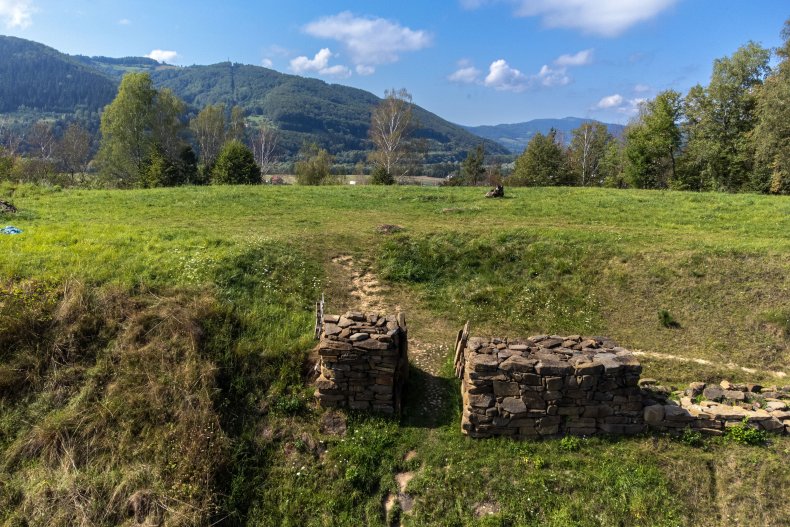
The prehistoric stone fortifications from Zyndram’s Hill in Maszkowice, discovered in 2015, provide a rare opportunity—particularly in the case of finds from such remote periods—to reflect on the style and function of defensive architecture.
The lecture by Dr hab. Marcin Przybyła, Professor at Jagiellonian University (Institute of Archaeology, JU), entitled “Prehistoric Stone Fortifications from Zyndram’s Hill – Reflections on Their Style and Function,” will present types of fortifications from the first half of the 2nd millennium BCE that employed stone as a building material. Particular attention will be paid to the shared characteristics of protocyklopaean architecture in southeastern Europe. The wall from Zyndram’s Hill represents a structure of this type.
The second part of the lecture will be devoted to considerations of the function of the earliest stone fortifications in Europe, with special emphasis on the potential symbolic significance of certain architectural elements.
Admission: 5 PLN
The lecture by Dr hab. Marcin Przybyła, Professor at Jagiellonian University (Institute of Archaeology, JU), entitled “Prehistoric Stone Fortifications from Zyndram’s Hill – Reflections on Their Style and Function,” will present types of fortifications from the first half of the 2nd millennium BCE that employed stone as a building material. Particular attention will be paid to the shared characteristics of protocyklopaean architecture in southeastern Europe. The wall from Zyndram’s Hill represents a structure of this type.
The second part of the lecture will be devoted to considerations of the function of the earliest stone fortifications in Europe, with special emphasis on the potential symbolic significance of certain architectural elements.
Admission: 5 PLN
Marcin S. Przybyła is an assistant professor in the Department of the Bronze Age and the Early Iron Age at the Institute of Archaeology, Jagiellonian University in Kraków. His research focuses on the Bronze Age in Europe, with particular emphasis on the Danube basin. He is also interested in the development of theoretical thought in archaeology and in the potential application of modern evolutionary theory to the study of past populations. The results of his research have been published in several dozen scholarly articles and books. Since 2010, he has directed archaeological excavations on Zyndram’s Hill in Maszkowice.


Góra Zyndrama w Maszkowicach